
About the Design of the Lasix ONYU Infusor

The Infusor was designed specifically for the administration of furosemide to patients with heart failure. We considered the needs of the patient, the provider, the payor and the environment.

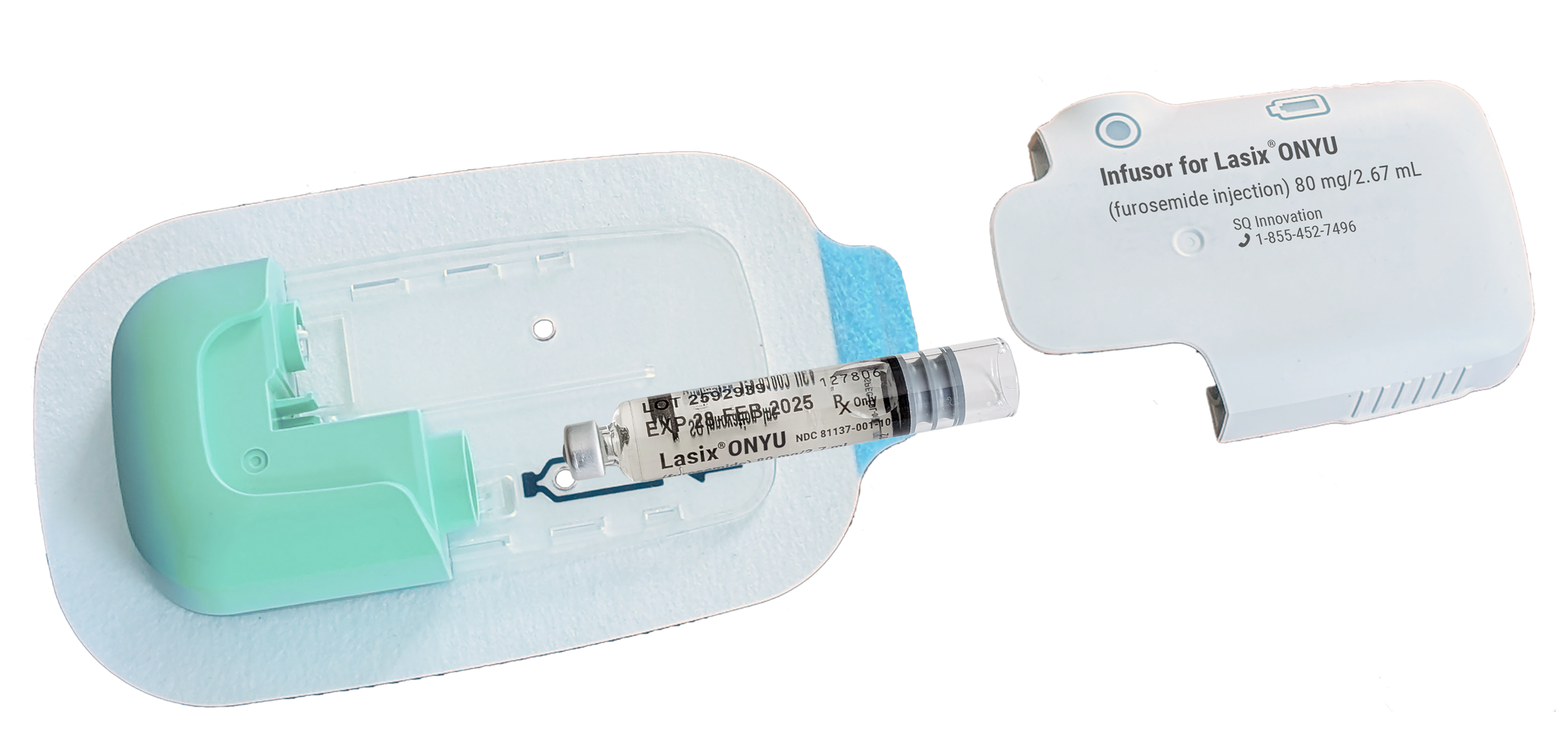
The Infusor has three components:

  1. Reusable Unit: A personal device that can be used up to 48 times. It contains a small electromotor, battery and electronics. It is charged before each each use, which takes less that 10 minutes.
  2. Disposable Unit: A sterile single use plastic component that includes everything in contact with the drug or body, including a very thin needle for the infusion. The needle comes out when the infusion starts and retracts at completion.
  3. Drug Cartridge: A prefilled glass cartridge containing 80mg furosemide in 2.67mL (30mg/mL).

Read Important Safety Information and the step-by-step instructions in the Instructions for Use before using the Infusor.

Parts of Infusor3
cta-img

Designed for the Patient

The patient is our most important customer. First, we wanted the Infusor to be small and light for comfort during use, and so we could use a more gentle medical tape. This may sound trivial, but the abdominal skin of the elderly is fragile and removing more aggressive tape may hurt and cause bruising or skin damage. We are using a 3M medical tape that has been used since 1980 and is known to be one of the most gentle medical tapes. Unfortunately, some patients may still have a reaction, which in most cases is slight redness that goes away quickly (See Important Safety Information and Prescribing Information).

Designed for the Provider

Treating worsening heart failure and decongestion have clinical workflows. We wanted our new treatment to fit how clinicians want to take care of patients with heart failure. One of the most common workflows is that the patient with congestion due to fluid overload will be seen in the outpatient clinic or Emergency Department. Some patients are too sick or going home is not an option. These patients need to be admitted for treatment. However, there are also patients who have bothersome symptoms due to fluid overload and who just need parenteral diuretic treatment. In other words, there is no other clinical reason for admission and the patient is a good candidate to be treated at home. In many cases, clinicians want to instruct the patient there and then. The best ways of doing this is by preparing the first treatment together. Our design allows training of the patient, preparing and placing the device and then having the patient travel home. Upon arriving home, the patient can press the button and start treatment. Our Infusor allows for 7 hours between placement and starting therapy — more than enough time for almost every patient to reach the comfort of their home.

designing for the provider 2
Doctor working on virtual screen with medical process .

Designed for the Payor

Money for healthcare is tight. Widespread adoption and easy availability requires that payors also benefit. At home treatment with Lasix ONYU should be one of the most affordable options available when the patient is a good candidate. Electronics are expensive and the materials they use are scarce. Patch pumps like the Infusor contain a motor, controllers (chips), LEDs, and a battery. Our Infusor can be used up to 48 times, after which it can be recycled. The DU is manufactured on a high-capacity robotic line. All combined, this allows Lasix ONYU to be affordable to the benefit of patient and payor. 

Designed for the Planet

Medical waste is incinerated and ends up in landfills. This includes single-use medical products with electronics. This is also an important reason why we selected the two-component design. Our two-component design assures that the electronic components and the battery are not part of the medical waste. First, the electronics can be used for 48 treatments and second, the electronics can be recycled. We also wanted to avoid chemical sterilization. Medical devices with electronic components are commonly sterilized with chemicals, most commonly ethylene oxide, a known carcinogen. Because of these concerns, the FDA, the US Department of Labor and the Environmental Protection Agency all promote alternatives to ethylene-oxide. Because the sterile single use component (DU) does not contain electronics, we can safely sterilize with radiation and avoid the chemicals.

Design4Planet
What is Lasix® ONYU (furosemide injection) for subcutaneous use?

Lasix ONYU is a prescription drug-device combination that treats edema caused by fluid build-up in a person with heart failure. Lasix ONYU comes with a special device that delivers the medicine under the skin. Follow the instructions provided by your healthcare provider when using Lasix ONYU.

IMPORTANT SAFETY INFORMATION

Before using Lasix ONYU, read the Instructions for Use and tell your healthcare provider about all your medical conditions, including if you are allergic to furosemide or any of the ingredients in Lasix ONYU, have trouble urinating, or if you are allergic to medical adhesives.

Tell your healthcare provider about all of the medicines you take, including prescription and over-the-counter medicines.

Warning: Only use the Lasix ONYU Prefilled Cartridge with the Lasix ONYU Infusor. Do not use insulin cartridges or other medicine cartridges in the Lasix ONYU Infusor. Doing so could cause severe injury.

What are the possible side effects of Lasix ONYU?

Dehydration: Lasix ONYU is a diuretic that can make you lose a lot of fluid and with it electrolytes. You may get a dry mouth, have increased thirst, get muscle pains or cramps, have reduced urine output or your urine may be more yellow than normal, you may get a headache, get dry skin, or have nausea or vomiting. Your healthcare provider may check your electrolytes while receiving Lasix ONYU.

Low Blood Pressure: Lasix ONYU may lower your blood pressure temporarily. You may feel lightheaded or dizzy. This usually happens when you stand. Getting up slowly may help.

High Blood Sugar: Lasix ONYU may increase blood sugar (glucose) levels if you have diabetes mellitus.

Loss of Hearing: Lasix ONYU can cause ringing in your ears. If so tell your healthcare provider.

Risk of Sunburn: Your skin may be more sensitive to sunlight while taking Lasix ONYU.

Infusion Site Reactions: Lasix ONYU can cause infusion site pain, bruising, and temporary swelling or redness at the site of the Infusor.

Incomplete Dosing: Make sure the Infusor does not get wet during use. Also limit your physical activities.  Some movements or when it gets wet may stop the infusion and you may not get all the medication.

These are not all the possible side effects of Lasix ONYU. For more information, ask your healthcare provider or pharmacist.

Call your healthcare provider for medical advice about side effects. You may report side effects to the FDA at 1-800-FDA-1088.

Please see Lasix® ONYU full Prescribing Information and Instructions for Use.

INDICATION & LIMITATION OF USE

Lasix® ONYU is a prescription drug-device combination that treats edema in adult patients with chronic heart failure.  It enables treatment outside the healthcare setting as instructed by a healthcare provider.

INDICATION AND USAGE

Lasix ONYU is indicated for the treatment of edema in adult patients with chronic heart failure.

Contraindications

  • Lasix ONYU is contraindicated in patients with anuria.
  • Lasix ONYU is contraindicated in patients with a history of hypersensitivity to furosemide or medical adhesives.
  • Lasix ONYU is contraindicated in patients with hepatic cirrhosis.


Warnings and Precautions

  • Fluid, Electrolyte, and Metabolic Abnormalities: Monitor serum electrolytes, CO2, BUN, creatinine, glucose, and uric acid.
  • Worsening Renal Function: Monitor for dehydration and azotemia.
  • Ototoxicity: Avoid higher than recommended doses.
  • Acute Urinary Retention: Monitor patients with symptoms of urinary retention.
  • Incomplete Dosing: Fluid contact and certain patient movements during treatment may cause the On-body Infusor to prematurely terminate infusion. Ensure patients can detect and respond to alarms.

Adverse Reactions

The most common adverse reactions during treatment with the Lasix ONYU Infusor were administration site and skin reactions: erythema, bruising, edema, and infusion site pain.

Drug Interactions

  • Aminoglycoside antibiotics: Increased potential ototoxicity of the antibiotics. Avoid combination.
  • Ethacrynic acid: Risk of ototoxicity. Avoid combination.
  • Salicylates: Risk of salicylate toxicity.
  • Cisplatin and nephrotoxic drugs: Risk of ototoxicity and nephrotoxicity.
  • Lithium: Risk of lithium toxicity.
  • Renin-angiotensin inhibitors: Increased risk of hypotension and renal failure.
  • Adrenergic blocking drugs: Risk of potentiation.
  • Drugs undergoing renal tubular secretion: Risk of toxicity potentiation.

Please see Lasix® ONYU full Prescribing Information and Instructions for Use.